Monday, May 21, 2012

Favorite Web Sites

1.  Starfall -- http://www.starfall.com/ -- is a favorite of younger kids age 2 and up.  Kids love the ABCs.
Starfall includes the the alphabet in Sign Language.  A little boy who is hearing impaired was amazed --he knew the signs!

"Starfall.com opened in September of 2002 as a free public service to teach children to read with phonics. Starfall's  systematic phonics approach, in conjunction with phonemic awareness practice, is perfect for preschool, kindergarten, first grade, second grade, special education, homeschool, and English language development (ELD, ELL, ESL). Starfall is an educational alternative to other entertainment choices for children."

2. Renlearn  [Renaissance Learning] specifically http://www.arbookfind.com/  is the site our library uses to find out it there is an Accelerated Reading Test (at the local elementary school & our library during the summer months) for a certain book.  At our library we label all known Accelerated Books.  It is a site I recommend  to parents so they can check their home library for books their kids can test on.


Wrap Up: Library Institute Spring 2012

1.  My biggest discovery?  There were so many!  Learning Express is amazing, so many different kinds of practice tests in so many different  fields or areas. I would have referred many patrons to this site if only I known. Besides the tests the ebooks, resume information, and courses make it a huge reference site.

2. So many areas of information to share with the community through the library's newspaper column. The availability of an ECard for library patron's home use & the databases available is my first item to share with readers (I've already passed it on to several library patrons).

I have used Heritage Quest for census records but hadn't gotten beyond that; it will be helpful for names of county histories and full texts of those histories for genealogists.

History and Genealogy Resources—Ancestry Library, Heritage Quest and Sanborn Maps

1.  I looked up my name on Ancestry Library and found three entries. One had a former route address, one with our current address,  and one with an incorrect address.
2.  In the 1930 census I found my Grandpa Nissen (Grandma Nissen had died in the Spanish flu epidemic) and my Dad living with my Great Grandpa & Grandma Carlson & Uncle Fats (an orchestra member).  Also two lodgers (that worked at the bakery) were staying at Great Grandpa & Grandma Carlson's.  I didn't know that my Grandpa Nissen had stayed with his in-laws at that time or that Uncle Fats was a band member at that time (he must have been a orchestra member all his life).

3.  Looking up "South Dakota" & pictures in the location box I was surprised to find so many professional baseball player from South Dakota.


4.    In Heritage Quest I found Wessington Springs with 51 listings with one obvious listings, A history of Jerauld County, South Dakota Wessington Springs, S.D.: unknown, 1910, 446 pgs.  The other listings when clicked on did not bring up Wessington Springs.  It would have taken a lot of digging if the Springs was mentioned at all. 
     In looking up my mother's maiden surname a history of that family's name could be obtained from an article in "Hampshire Family Historian" Gosport, Hants, England:  Nov 1991 from Persi for a fee of $7.50 (with no idea if it was relevant to our family or not).


5.  Wessington Springs was not listed under Sanborn Maps. In 1930 Woonsocket had 2 drug stores, a Photo Shop,  and a moving pictures theatre.  I believe where the print shop was located is where the newspaper office is located today.

Sunday, May 6, 2012

Week 4 Lesson 7 -- WorldCat and More FirstSearch Indexes

1. Using the keyword search for the Missouri River -- 32,810 results (English 28,988) came up.  Results were found in the following areas:  Books, Internet, Maps, Archival, Visual Sound, Serials, Articles, Scores, Computer, and Updated Resources.

2. Using "Books" and the Title Phrase search for Secrets of a Wildlife Watcher  -- with 1,339 results (4 libraries in South Dakota listed first then library's from surrounding states were listed. The top library Madison Pub Libr --File or Directory not found.

3. The call # for Secrets of a Wildlife Watcher was 591.5. Siouxland library was listed #2 with 54 books other books written by Jim Arnosky.  Thunderbirds was written in 2011.


Life size eagles, hawks, owls, with fold outs.

This book is of interest since library patrons have been watching the eagle web cam from Decorah, Iowa -
 http://www.ustream.tv/decoraheagles.  Last year we had a pair of barn owls raised a family in our barn.
   By clicking the Subjects category on the left side -- more titles of wildlife books were found.


Other FirstSearch Indexes
   Two databases I found of interest was the OCLC Ebooks to look up available Ebooks and the World Almanac with Funk & Wagnalls Encyclopedia and 4 almanacs.  A library patron uses almanacs from time to time and this will give the person 4 almanac choices.

Discovery Exercise part 2
   Using OAIster I selected "Log Shanty with Flag, Woman, and Seven Boys."  When clicking to full screen, the logs used for the roof could be seen closely to see how the roof was made. A tree branch or young tree was used for the flag pole -- very interesting -- such a desolate scene.
   "The Bat Survey of the Sioux District" could be viewed by several different means. I chose the PDF.
     

Tuesday, May 1, 2012

Lesson 4 ProQuest

1. I looked up two cities --Wessington Springs South Dakota and Spanaway Washington, and the Pugent Sound. At first it looked like mainly outdated police reports, scientific reports having to do with enviromental studies, etc., and governmental issues. As I looked further down the numbered items in the Spanaway search "the Current Hazardous Sites List and past lists" came up (from the US Fed News Service, Including US State News) -- something I had never thought about looking up.  The more a person looks the more you find.

1a. I checked the Cville Library blog search in ProQuest on Huntington’s disease.  I liked the search process in limiting the search to find out specific information.  It gave me the idea to check different diseases and medical problems. 
  
I then looked up some X-linked genetic diseases --the results would be of interest to someone looking up research studies. When typing in a search item the automatic recommended search terms was very helpful, as Cville Library had mentioned.


2.  In "The Horn Book Magazine" I looked up iPad apps with 4 results.  I found several recommended apps such as Freight Train (Curious Puppy) by Donald Crews and Pop-Out! The Tale of Peter Rabbit (Loud Crow Interactive) by Beatrix.  Initially I was disappointed with no illustrations until I clicked on full text, nice colored pictures!  Clicking on the right side bar "see similar documents" gave more article options.

Wednesday, April 25, 2012

Lesson 2  Learning Express Library
1. I had never used Learning Express Library. Wow! Amazing how many practice tests the Library has.Last summer a fellow was studying to take his CDL test and asked for some practice tests -- I found some on the internet--it would have been faster using Learning Express Library.  The U.S. Citizenship test and the TOEFL practice test would have been used by two different library patrons -- if I'd only known.
2. I took the CDL test. I thought the explanation to incorrect answers was very thorough -- especially helpful since I don't drive a semi-truck.  The questions were comparable to the quizzes I found this summer. I found this practice test to be very good.
3. "Creating a Great Resume" was thought provoking on what should be in a resume and the reasons why. The common standards for formating the paper and the quiz for which format is right for you were helpful.
Patrons come into the library seeking these skills.
4. The eBook "U.S. Constitution in 15 Minutes a Day" gave a lot of historical background to the Constitution.  The text was easy to understand and taking a pretest made sense plus it gave you an idea of the subject information that would be in the eBook. I found the book interesting.

Thursday, April 5, 2012

 Lesson 1 -- World Book Online
1.The World Book Online homepage for Kids Grades K-5 was very colorful--the colored lines running up and down with the pleated look was a little too busy for a child with vision problems--a little too much to focus on, I thought.  I chose to research the mountain lion.  My husband saw an older cub 1 1/2 miles from our house a few years ago.  A trapper saw mountain lion tracks by a dugout 2 miles south of our house this past winter. 
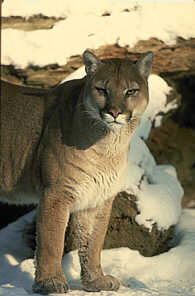
     The Quick Facts give a lot of information in a concise & easy to read format in a small space.  Kids would think this is great not having to read alot to pick out the information.
     How to cite the article for a paper is very helpful.  
     The Animals of British Columbia link to cougar info gave a front & hind foot picture, I found that helpful for keeping our eye out for prints in the area of our ranch.
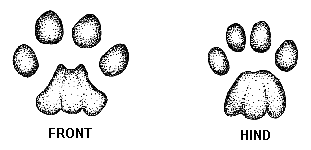
Cougar Tracks
"Tracks - The cougars tracks rarely show evidence of the claw. The front feet are larger than the rear and generally the toes spread wider with speed. A distinctive feature of this creature in snowy areas is tail marks on the snow. "  Interesting information!

The habitat was not specific in this article "They once lived throughout the forests of the United States and southern Canada. When settlers moved into these areas, they drove most of these animals out. Today, mountain lions are most common in Mexico, Central America, and South America. Some also live in Canada and the United States, especially in the western parts of these countries."

2. Info Finder gave more detailed information about mountain lions (ex. detailed info of the lion's cubs and the raising of the cubs). The print in Info Finder was smaller and geared to a higher reading level.  You could link to special reports and magazine articles and it listed the scientific classification. In both articles the text could be read to you (allowing students to read along with the reader) -- so helpful for students who struggle with reading,  Both articles could be translated into many languages.

3. The country I chose was Canada. It was a country that I felt I may actually visit someday. The Reference Center home page was not cluttered, I found it a lot easier to read --not bombarding kids with so many designs on one page like the Kids Grades K-5 homepage.
      I liked the way the Canada page was set up with the various links on one page, patrons would easily see what is available for research on that country.  I liked the small colored pictures on the middle of the page, it was the first thing I wanted to click on.

In the reference center under eBook Anderson's Fairy Tales  the story "The Goloshes of Fortune" could be compared to the special reports comparison with England's monarchy of 2000 -- The Queen Mother: Creator of the Modern Monarchy (giving kids a past story and modern day real life comparison) Very helpful for an Enlish class comparison study.
     With the eBook pages for The Adventures of Huckleberry Finn there was more related information -- (ex. primary sources and web sites).  There was also related encyclopedia content (author, other books written by Twain, Hannibal, Missouri, etc.).  Researching one area leads to many, many other areas.